How Green Are You?
Today everyone in the world measures their 'Being Green' by their carbon footprint. We measure carbon footprint by the amount of resources we directly use - such as using paper or plastic, driving inefficient vehicles emitting carbon dioxide and other deadly gases, using electricity, and so on.

However, more accurate way to measure carbon footprint would be to also include the indirect emissions of harmful gases, especially when the indirect emissions cause more damage than the direct use. Would you agree?
What is EPA telling you?
As per Environmental Protection Agency, in 2013,
- 5500 million tons of CO2 was released
- 630 million tons of Methane was released
- 350 million tons of Nitrous Oxide was released
This of course would mean that by reducing CO2 emissions we achieve our goals of being greener. But there is one other thing EPA is saying which we all overlooked:
- Global Warming potential of Methane is 30 times that of CO2 and Global Warming potential of Nitrous Oxide is 298 times that of CO2.
So in reality, Methane and Nitrous Oxide released in atmosphere is far more harming than CO2. Moreover, while some of CO2 is naturally consumed by trees and forests across the USA, Methane and Nitrous Oxide continue to stay in atmosphere for a long time (12 to 114 years).


Causes
So the question is - where do Methane (CH4) and Nitrous Oxide (N2O) come from?
- 30% of 630M tons of CH4 was produced by Agriculture Industry.
- 80% of 350M tons of N2O was produced by Agriculture Industry.
So, in reality, Agriculture Industry alone produced several times more CO2 than all the other sources combined if you also consider the global warming potential of these gases.
Further breakdown
- Every crop that is produced need fertilizers and every animal that is raised for dairy or meat needs food, water and produces waste.
So further breakdown is -
- 65% of the N2O produced by farms was actually produced by the livestock.
- 75% of the CH4 produced by farms was actually produced by the livestock.
- The fertilizers used for animal feed has a very high content of nitrogen to increase the production of the feed to meet the demands of the livestock. That is why the farms producing animal feed emits lot more N2O compared to other farms.
- Raising livestock also needs much more land than producing food for humans which leads to deforestation in many parts of the world, which then leads to lack of CO2 consumption by trees.


More Facts
Animal Agriculture has
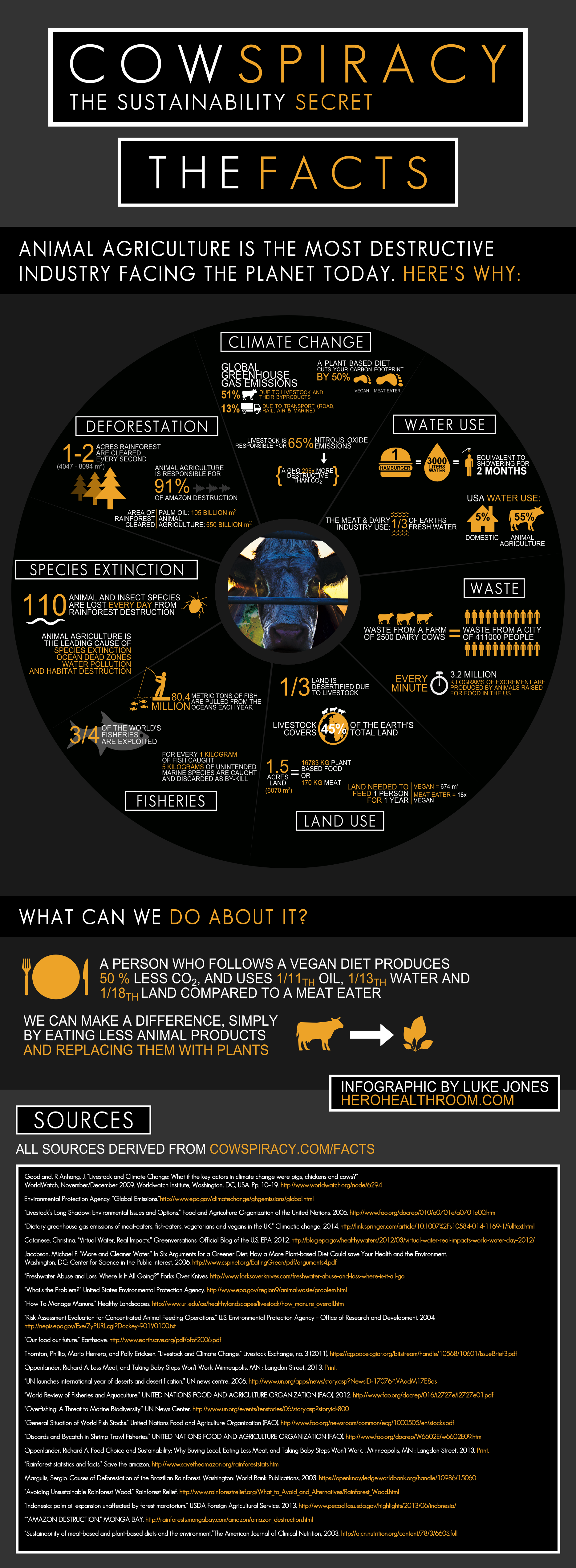
- desertified 1/3rd of the world's land
- been using 11 times more water than all homes (in USA)
- caused deforestation of 136 million acres of forests in the world
- been using 1/3rd of world's total freshwater supply
- been using 50% of the total grain produced in the world, just to feed the livestock.
Waste generated from a farm with 2500 dairy cows is equivalent to waste generated from a city with 411,000 humans.
Animal pastureland acreage across the world is 60% more than all the human-developed land.

Meat vs Dairy vs Plants
In USA, 1.5 acres of land can produce 37000 lbs of plant based food for humans while the same land can effectively produce only 375 lbs of meat.
Plant based diet can feed one person for one year with just 1/6th acre of land. While meat-based diet will need 3 acres.
On any given land, 15X more protein can be produced with plant based food than raising animals for meat.
1 lb of lamb produces 39 times CO2 compared to 1 lb of lentils.
Beef = 27X
Cheese = 13X
Turkey = 11X
Chicken = 7X
Pork = 12X
Eggs = 5X
Milk/Yogurt = 2X

Cheese = 13X
Turkey = 11X
Chicken = 7X
Pork = 12X
Eggs = 5X
Milk/Yogurt = 2X

- Eating 1 lb of beef is as harmful to the environment as driving a car for 60 miles
- Eating 1 lb of lamb is as harmful to environment as driving a car for 65 miles
- Eating 1 lb of chicken is as harmful to environment as driving a car for 20 miles
Meat consumption on the rise
In the last sixty years, meat based calories per capita has increased by 30%.

With lifestyle being less-active than ever before, consuming more meat is unnecessary and causing more health issues for the general population.

Balancing Act
- A farm that produces more meat and dairy in non-sustainable way, will produce more N2O, will use much more antibiotics and will cause more problems related to waste management and will produce a lot of methane.
- So either way, raising animals for food is hurting the environment much more than any other human activity. It is like putting a large input to generate a very small output, like in a highly inefficient system.
- There is practically no way to produce more meat and dairy without increasing the environmental damage it has been causing. Most of the damage it has caused in last few centuries has been irreversible.
Wrap-Up
- Carbon Footprint calculation for a person/entity must include the type of food they eat/provide/consume.
- Once we have the data, we will all be able to choose wisely.
- There are several solutions proposed by several non-government agencies - most of which suggest to increase the plant based diet and reduce the meat and dairy to the lowest level possible.

Just like when eating high-fat food one thinks about weight gain and exercise, one should also think about the environmental damage before they eat their next chicken, cheese, turkey, beef or lamb. If everyone did that, we can reverse the climate crisis.
Thank you


Just like when eating high-fat food one thinks about weight gain and exercise, one should also think about the environmental damage before they eat their next chicken, cheese, turkey, beef or lamb. If everyone did that, we can reverse the climate crisis.
Thank you

References
- http://www3.epa.gov/climatechange/ghgemissions/gases.html
- http://www.cowspiracy.com/infographic
- http://static.ewg.org/reports/2011/meateaters/pdf/methodology_ewg_meat_eaters_guide_to_health_and_climate_2011.pdf
- http://www.nationalgeographic.com/what-the-world-eats/
- http://www.nationalgeographic.com/foodfeatures/feeding-9-billion/
- http://www.nationalgeographic.com/what-the-world-eats/
- http://www.nationalgeographic.com/foodfeatures/meat/#
- http://www3.epa.gov/carbon-footprint-calculator/